

 Posts
Posts


This week we continue plugging along. Not a lot of activity. Actually we spent a good part of the week packing braided straps and meters. We received a shipment of 20 meters and had a bit of a backlog to fill, so it kept me busy casting shunt bases and Brain in packing boxes. We are also moving a lot of the braided straps. If this keeps up we'll have to order another brazillian.
And this is a bit of a business lesson. Whatever you are trying to do, be aware of signals that something else might be afoot. We've been struggling manfully to get some of these vendors to cough up fairly piddlin amounts for commercial advertising - 1 minute ads in our show. They've been oddly resistant.
I could be sympathetic, but recently had cause to learn what a huge discount they are giving to their dealers - often more than they make themselves from the product. I've written on the flattening effect of the Internet on dealer networks for many years. That we still had them going strong in EVland was kind of missed. And I have to say I don't get it.
But when in Rome.....
This week we received our polyurethane motor mounts that we are going to use on the Escalade. This is kind of an important issue. We need to hold 450 lbs in position, keep it from turning with 350kw of power applied, and ideally we do not want to transmit any vibration to the frame of the car.
This last can be a surprisingly annoying and often overlooked aspect to an EV build. We've never really talked about it although you've watched us do it build after build. Basically, you want some sort of rubber or urethane shock mount between any vibrating motors and your vehicle, to prevent the vibrations from entering the passenger compartment, traveling up the seat back supporting structure, and entering the fillings in your back teeth. This can be terribly annoying if you forget to do this.
And so, polyurethane shock fittings. Used for many years with ICE engines, which also vibrate annoyingly.
They basically absorb vibrations in the flexible material, isolating the vehicle from the vibrating or oscillating motor.
These cost $142 I think for two basically urethane cylinders with a top and bottom steel piece and a hole through it. A bolt through it holds it in position, and does transmit a bit of vibration, but most of the weight is carried on the flexible chunk which absorbs a lot of the vibration.
Not much happening on the flatten 'em series. I am building a 2x2 inch by 1/8th aluminum angle frame around the bottom section at the moment. We'll add the second section to that soon. Bottom balance both at 2.65 volts or thereabouts. Add a third section for a bandwidth of 4.5-5.0 inches. I may work in a Kilovac relay to allow me to turn this pack on and off remotely, and perhaps a separate fuse for it.
We tested our last 12v monolithic that we cast in the pink silicon rubber last week. It came in at about 117 Ah very nicely. Good battery. We may have to make a set of the terminal tops and some drawings and see what we can do with a machine shop to have some of those made up professionally as fas as the terminals go.
We did receive a new shipment of 500 of the A123 cells. We're gaining confidence in our CHinese supplier and the cells themselves. I guess I do NOT think these cells are as good a solution as a CALB 180 prismatic for an electric car. But the smaller granularity with the much higher power output offers a significant advantage - smaller battery packs of less CAPACITY that still offer the same power output at any given instant. As we've said numerous times, this opens the door to a pack of less expense, but consequently less range, while still retaining full operation of the vehicle.
The bad news is that you basically have to engineer a structure for the cells. And that is additional expense, effort, and time. If you can swap sweat equity for money, it can be a strategy. If you spend as much on the module as you would have with the CALB 180's in the first place, you lose all the way around. Not a great strategy.
Flatten em looks too heavy and too expensive to make sense. It's main advantage will be I can bolt it on underneath a car for testing purposes. It could be a model for a very light Speedster where that was the sole supply and we accepted a 35 mile range in the car in exchange for lightness which is of course next to Godliness in the land of the EV.
Nine or 10 of our monolithic 12volts would probably make more sense with a 120v pack of 115 AH. That would be more of a 50-60 mile car and more practical. Probably a lot easier to put together. But the resin is a significant expense.
Nine of those would make a nominal 120.4 volt pack of 288 lbs and 115 Ah.
For those wishing to experiment, we are offering these cells in small quantities at $31 each. We have them in the EVTV online store.
We included the WSIU PBS piece in this week's episode more or less for archival purposes. But it was March last year when we first announced a little gathering at the shop that grew into EVCCON 2011. And so we kick off the season. More on the event and registration at http://www.evtv.me/evccon.html
We had most of our sessions, our vendor area, and quite a few of the meals in my hangar at Cape Girardeau Airport last year. It's about 18,000 sf and it was pretty comfortable for the number of attendees we had. If that number were to go up even modestly, it would quickly become uncomfortable. And so we have purportedly contracted to take the entire Show Me Center Arena here in Cape for our educational sessions, most meals and the vendor area. It's about 32,000 square feet and so unless we just have a blowout event, it should be quite comfortable.
I see Willie Nelson is in Concert there April 8th. I think he'll have cleared the area by our September 26th event. What famous singers are associated with electric vehicles?
Jack Rickard
Monday, March 26, 2012


Wednesday, March 21, 2012
Electric Vehicles - Deathly Quiet
Again, we're struggling to come up with a show. There just isn't ANYTHING happening at the moment that we can find ANYWHERE. All online forums, blogs, and other EV news sources are MORIBUND.
Oh, I guess Coda has shipped two cars. And Wheego has sold 36 EV's in the past year and the company president has announced that that's just what he wants and just what he planned all along. He's been reading too many Volt press releases. The Volt production line is currently shut down.
And so doing my normal early Friday morning perusal of the wires and press releases and blogs, trying to find some gems for your consideration this week, there was NOTHING. I mean NO news.
Chris Paine of course produced "Who Killed the Electric Car" and of course this year's documentary "Revenge of the Electric Car" which he graciously previewed at our EVCCON in September. One of his favorite recharge stops is BURNING MAN in the Black Desert. Now a 50,000 person annual event with a hideous and growing set of laws and regulations, he did deliver a talk there that basically said that if no one buys these electric cars during this "window" change is not going to occur.
He was basically acknowledging the same phenomenon we predicted nearly two years ago - very meager sales. His take is that the consumer is not sufficiently dedicated to the cause. My take is the value proposition presented is poor and the consumer is no dummy when it comes to counting their ducats.
At this point, the excuses have all rung hollow and faded away. The "next month in Jerusalem" talk is pretty much over. And the finger pointing has begun. According to Lutz, it's conservatives using the Volt as a political football. To others, it is proof positive of range anxiety. It's another Obama plot.
And as that dies down, we are left with....nothing. No news. No commentary. No developments. ALL the press release announcements from those NOT actively producing a car fall prey to the wait and see what happens to the Volt and Leaf. You will find all those firm plans can just as easily be changed with another press release.
I find Nissan's announcement of new models and the $9900 ChaDemo fast charger heroic in the breech. I'm actually starting to pull for this gutsy little French dwarf with the Italian suit and shoes. In the face of a total meltdown of a couple BILLION dollar bet, he's talking "double down."
I again predict the Tesla Model S will re-energize the thing, but add FURTHER confusion when they come out selling well. Ironically, the numbers won't be much different. But for them to sell 10,000 cars in a year will be viewed as a blowout victory, where for Nissan to do the same thing is viewed as a horrifying train wreck of a failure. Expectations. It's all about expectations.
Note that all along I've been talking about VALUE PROPOSITION. Not PRICE. They are different things.
A $100,000 car is of course expensive. If it comes with 120 lbs of gold bar in the trunk - it is a good value proposition. You can stop off, sell the gold for a couple of million, and keep the car.
A $32,000 car is not very expensive. Of course, if it is a dead clone of a $19,000 car, but electric, not a good value proposition.
As an ENTIRELY new model, on an ENTIRELY new production line, ENTIRELY manned by people who have never been in the automobile business, the odds of Tesla delivering a functional car that doesn't crater itself Fisker fashion are pretty slim. I will predict the issues with the Tesla S will be modest and software related. And within a year of introduction, this car will be touted as one of the greatest sedans ever designed worldwide of any kind and any power train. And sell perhaps as many as 20,000 in 2013.
That's going to further stun the pundits, along with the 44% short sale in TSLA stock who wind up with their panties around their ankles, and entirely out of altitude, airspeed, and ideas at more or less the same moment.
Fear. Uncertainty. And doubt. How ironic that the companies seeking to sow it are now the ones reaping it. FUD.
Meanwhile we struggle for life. We should be overrun with advertisers at this point. We have built a great following of some great viewers all pretty passionate and engaged in the sport of divining the next great movement toward galvanic magnetic propulsion. This should be ENORMOUSLY attractive to advertisers unless I know NOTHING about publishing.
We had one vendor run an ad for six months and experience great growth. They then dropped the ad. Growth slowed. And their conclusion? They have reached MARKET SATURATION.
I don't know whether to laugh or to cry. This is the most absurd situation I can recall facing.
We've been doing some little experiments. Recall that I had a little trouble with getting my very excellent braided straps from Australia because of the shipping charges. Oh EV works hosed up one order because of a change in size of the terminals on the 400Ah cells they were unaware of. But the real issue was huge shipping.
So we sourced the straps ourselves and of course came up against the problem that they wanted to sell us one BRAZILLION straps, and we needed 75. Interesting experiment here. We can't get them stateside for less than $20. Let's go ahead and ORDER the brazllion. The shipping IS substantial but for some reason NOT what it is from Australia. And we'll offer the straps to our viewers.
We sold out of the straps in two weeks. We reordered ANOTHER brazillian and we're looking at a third order at the moment. The guy selling them to us wants us to look at his tinned copper cable terminals as well.
We found this little Ampere Hour meter that had actually been DISCONTINUED. We talked the guy into importing them again and we wrote a little manual for it. Cast the goofy Chinese shunts into some nonconducting resin so you could mount it, added a 12v-12v converter to close the door on any isolation issues, and we sold OUT in 10 hours.

We reordered 20 of them. We have four left. I've ordered 32 more.
I guess I'm not having the same problem justifying advertising on EVTV that my advertisers are. What's going on?
It's true, that some of our viewers have just been curiously supportive. I'm not sure they NEED braided straps right now, but they will and they wanted to show the flag. We appreciate it. Ironically, I had an order for the METER from AUSTRALIA and he's a little butt hurt over the $134 shipping charge - Fedex and UPS being within a dollar of each other. I don't know how to tell him that's where we started.....
And now I have Matt Hauber of EVWest calling to take me to task for COMPETING with them as a dealer. Wait a minute. We never HAVE had any dealer advertisers. What's with that. Why would I worry about competing with them?
MORE comically, I get on YouTube, and this onetime EVTV intern has started his own series of videos under the EVWest umbrella. What's good for the goose is NOT good for the gander? Actually they are not bad. You might have a peek. Very hands on, how to, just like he learned here in Missouri. He even kind of labors to mimic my labored Pall Mall limited breathing and talking style.
But it puts me in mind to fulfill his phears. What would EVTV look like as a dealer? We're not stepping on any dealer toes as we've never HAD any dealer advertisers. And the same component developers who are very shy about a commercial contract are EXTREMELY generous to their "dealers" often ceding a huge markup.
I have to tell you, I don't quite get the dealer thing in the first place for some of these companies. Understand that I was more or less famous for an editorial I wrote in the very early 1990's where I predicted the worldwide wholesale collapse of dealer networks because of the Tim Berners-Lee's World Wide Web.
When the dealer web site and the manufacturer's website are geographically separated by one click of the mouse, the whole house of cards kind of comes tumbling down. If you took the dealer markup and split it, the manufacturer gets half more profit and the end user gets a lower price. What happens to the value add from the dealer? What WAS the value add from the dealer?
For a dozen years since, as hundreds and HUNDREDS of these networks have gone down in flames just as I predicted, the chant has been the same. SERVICE, SERVICE, SERVICE. And the end user has gone for the same thing instead, PRICE, PRICE, PRICE. And in every case I've examined, the problem was the dealer wasn't DELIVERING the service.
The relationship was based on the manufacturer believing the dealer brought them sales from the local area. And in those days indeed dealers stocked product as well as spare parts, made repairs, etc. It all made sense.
With the Internet, the manufacturer is empowered to deal with customers directly, wherever they are located physically. With UPS and Fedex, items can be shipped overnight, products returned, etc.
Local John Deere dealer, Cape Girardeau Missouri. Case in point. Sells John Deere lawn mowers. It gets to be spring, and I take mine in for repair. The guy looks me RIGHT in the eye - "twelve week backlog buddy."
WTF. I'm not going to NEED a lawn mower in August champ. In fact, he was rude about it. I felt like I was intruding even ASKING him to repair a lawn mower I'd bought from him a year before.
Feet don't fail me now. It's off to Walmart.
One year later, I run into him in a restaurant. He's lamenting that at age 50 he has lost his dealership - everyone's buying at Walmart or Online, and he has to start all over. Where are they going to get SERVICE he bleats plaintively. I bight the last inch of my tongue off completely and roll it around in my mouth. "Twelve week backlog buddy". Had he WANTED to provide service, he simply would hire a couple of extra mechanics for the spring season. He wasn't to be bothered. He's unemployed.
What service? The manufacturer drop ships the product and answers most of the questions. Very little value add going on out there that I can see. And it's easy to add. How about writing some INSTRUCTIONS to go in the box guy. I can't tell you how many times I've ordered parts and received them, with NOTHING in the box. I can't even tell what the part number is.
So we have a new world changing technology trying to reinvent distribution networks of the 1950s.
I understand my 500 new A123 cells are in St. Louis being held up by DHL as usual. Should be here in a day or two. We've added these to the EVTV store at $31 each. Yes, I know that's more than what I paid. Duh.

Fortunately, it also covers the $1985 shipping and the $450 Paypal surcharge. And we'll have to repackage them to go out. We intend to offer them for those viewers that want 8 or 16 or 32 or something to play with, test, experiment with, etc. After they have that all worked out, it would make sense to go through the angst of dealing with the Chinese directly for larger numbers. But this will work well enough for our viewers to get to play with them and test them and see for themselves before committing to a larger order. And yes, we'll unapologetically make a couple of ducats per cell on the deal.
The other thing on my mind these days is that March was about when we kicked off the idea of an Electric Vehicle Conversion Convention last year. We got quite a surge of signups. We sincerely hope and plan for a larger and better convention this year. Registrations are $595 again this year, with a discount to $400 between now and 1 June. IF you bring a car, we will discount that to $99 each for up to two people per car recognizing the not inconsiderable expense of shipping a car out here. Ask those that did last year if it was worth it. THey had a blast. To register: http://www.evtv.me/evccon.html
As noted last blog entry, David Kidd did a fascinating little 30 minute documentary on EVCCON 2011 I found quite engaging..
Bottom line is that I think we are facing a great future of unlimited potential with thousands of very interesting and passionate people engaged in a holy mission to change the world for the better, at least when it comes to energy usage. That there are a BILLION cars on the road as of July 2010, and each could be made 7-8 TIMES more efficient at energy usage while doing the same job is a HUGE benefit to mankind and the wobbly little blue marble we ride on. I'm neither dazed nor confused and in fact energized by excitement as to all the good things to come.
Feet don't fail me now.....
Jack Rickard
Oh, I guess Coda has shipped two cars. And Wheego has sold 36 EV's in the past year and the company president has announced that that's just what he wants and just what he planned all along. He's been reading too many Volt press releases. The Volt production line is currently shut down.
And so doing my normal early Friday morning perusal of the wires and press releases and blogs, trying to find some gems for your consideration this week, there was NOTHING. I mean NO news.
Chris Paine of course produced "Who Killed the Electric Car" and of course this year's documentary "Revenge of the Electric Car" which he graciously previewed at our EVCCON in September. One of his favorite recharge stops is BURNING MAN in the Black Desert. Now a 50,000 person annual event with a hideous and growing set of laws and regulations, he did deliver a talk there that basically said that if no one buys these electric cars during this "window" change is not going to occur.
He was basically acknowledging the same phenomenon we predicted nearly two years ago - very meager sales. His take is that the consumer is not sufficiently dedicated to the cause. My take is the value proposition presented is poor and the consumer is no dummy when it comes to counting their ducats.
At this point, the excuses have all rung hollow and faded away. The "next month in Jerusalem" talk is pretty much over. And the finger pointing has begun. According to Lutz, it's conservatives using the Volt as a political football. To others, it is proof positive of range anxiety. It's another Obama plot.
And as that dies down, we are left with....nothing. No news. No commentary. No developments. ALL the press release announcements from those NOT actively producing a car fall prey to the wait and see what happens to the Volt and Leaf. You will find all those firm plans can just as easily be changed with another press release.
I find Nissan's announcement of new models and the $9900 ChaDemo fast charger heroic in the breech. I'm actually starting to pull for this gutsy little French dwarf with the Italian suit and shoes. In the face of a total meltdown of a couple BILLION dollar bet, he's talking "double down."
I again predict the Tesla Model S will re-energize the thing, but add FURTHER confusion when they come out selling well. Ironically, the numbers won't be much different. But for them to sell 10,000 cars in a year will be viewed as a blowout victory, where for Nissan to do the same thing is viewed as a horrifying train wreck of a failure. Expectations. It's all about expectations.
Note that all along I've been talking about VALUE PROPOSITION. Not PRICE. They are different things.
A $100,000 car is of course expensive. If it comes with 120 lbs of gold bar in the trunk - it is a good value proposition. You can stop off, sell the gold for a couple of million, and keep the car.
A $32,000 car is not very expensive. Of course, if it is a dead clone of a $19,000 car, but electric, not a good value proposition.
As an ENTIRELY new model, on an ENTIRELY new production line, ENTIRELY manned by people who have never been in the automobile business, the odds of Tesla delivering a functional car that doesn't crater itself Fisker fashion are pretty slim. I will predict the issues with the Tesla S will be modest and software related. And within a year of introduction, this car will be touted as one of the greatest sedans ever designed worldwide of any kind and any power train. And sell perhaps as many as 20,000 in 2013.
That's going to further stun the pundits, along with the 44% short sale in TSLA stock who wind up with their panties around their ankles, and entirely out of altitude, airspeed, and ideas at more or less the same moment.
Fear. Uncertainty. And doubt. How ironic that the companies seeking to sow it are now the ones reaping it. FUD.
Meanwhile we struggle for life. We should be overrun with advertisers at this point. We have built a great following of some great viewers all pretty passionate and engaged in the sport of divining the next great movement toward galvanic magnetic propulsion. This should be ENORMOUSLY attractive to advertisers unless I know NOTHING about publishing.
We had one vendor run an ad for six months and experience great growth. They then dropped the ad. Growth slowed. And their conclusion? They have reached MARKET SATURATION.
I don't know whether to laugh or to cry. This is the most absurd situation I can recall facing.
We've been doing some little experiments. Recall that I had a little trouble with getting my very excellent braided straps from Australia because of the shipping charges. Oh EV works hosed up one order because of a change in size of the terminals on the 400Ah cells they were unaware of. But the real issue was huge shipping.
So we sourced the straps ourselves and of course came up against the problem that they wanted to sell us one BRAZILLION straps, and we needed 75. Interesting experiment here. We can't get them stateside for less than $20. Let's go ahead and ORDER the brazllion. The shipping IS substantial but for some reason NOT what it is from Australia. And we'll offer the straps to our viewers.
We sold out of the straps in two weeks. We reordered ANOTHER brazillian and we're looking at a third order at the moment. The guy selling them to us wants us to look at his tinned copper cable terminals as well.
We found this little Ampere Hour meter that had actually been DISCONTINUED. We talked the guy into importing them again and we wrote a little manual for it. Cast the goofy Chinese shunts into some nonconducting resin so you could mount it, added a 12v-12v converter to close the door on any isolation issues, and we sold OUT in 10 hours.
We reordered 20 of them. We have four left. I've ordered 32 more.
I guess I'm not having the same problem justifying advertising on EVTV that my advertisers are. What's going on?
It's true, that some of our viewers have just been curiously supportive. I'm not sure they NEED braided straps right now, but they will and they wanted to show the flag. We appreciate it. Ironically, I had an order for the METER from AUSTRALIA and he's a little butt hurt over the $134 shipping charge - Fedex and UPS being within a dollar of each other. I don't know how to tell him that's where we started.....
And now I have Matt Hauber of EVWest calling to take me to task for COMPETING with them as a dealer. Wait a minute. We never HAVE had any dealer advertisers. What's with that. Why would I worry about competing with them?
MORE comically, I get on YouTube, and this onetime EVTV intern has started his own series of videos under the EVWest umbrella. What's good for the goose is NOT good for the gander? Actually they are not bad. You might have a peek. Very hands on, how to, just like he learned here in Missouri. He even kind of labors to mimic my labored Pall Mall limited breathing and talking style.
But it puts me in mind to fulfill his phears. What would EVTV look like as a dealer? We're not stepping on any dealer toes as we've never HAD any dealer advertisers. And the same component developers who are very shy about a commercial contract are EXTREMELY generous to their "dealers" often ceding a huge markup.
I have to tell you, I don't quite get the dealer thing in the first place for some of these companies. Understand that I was more or less famous for an editorial I wrote in the very early 1990's where I predicted the worldwide wholesale collapse of dealer networks because of the Tim Berners-Lee's World Wide Web.
When the dealer web site and the manufacturer's website are geographically separated by one click of the mouse, the whole house of cards kind of comes tumbling down. If you took the dealer markup and split it, the manufacturer gets half more profit and the end user gets a lower price. What happens to the value add from the dealer? What WAS the value add from the dealer?
For a dozen years since, as hundreds and HUNDREDS of these networks have gone down in flames just as I predicted, the chant has been the same. SERVICE, SERVICE, SERVICE. And the end user has gone for the same thing instead, PRICE, PRICE, PRICE. And in every case I've examined, the problem was the dealer wasn't DELIVERING the service.
The relationship was based on the manufacturer believing the dealer brought them sales from the local area. And in those days indeed dealers stocked product as well as spare parts, made repairs, etc. It all made sense.
With the Internet, the manufacturer is empowered to deal with customers directly, wherever they are located physically. With UPS and Fedex, items can be shipped overnight, products returned, etc.
Local John Deere dealer, Cape Girardeau Missouri. Case in point. Sells John Deere lawn mowers. It gets to be spring, and I take mine in for repair. The guy looks me RIGHT in the eye - "twelve week backlog buddy."
WTF. I'm not going to NEED a lawn mower in August champ. In fact, he was rude about it. I felt like I was intruding even ASKING him to repair a lawn mower I'd bought from him a year before.
Feet don't fail me now. It's off to Walmart.
One year later, I run into him in a restaurant. He's lamenting that at age 50 he has lost his dealership - everyone's buying at Walmart or Online, and he has to start all over. Where are they going to get SERVICE he bleats plaintively. I bight the last inch of my tongue off completely and roll it around in my mouth. "Twelve week backlog buddy". Had he WANTED to provide service, he simply would hire a couple of extra mechanics for the spring season. He wasn't to be bothered. He's unemployed.
What service? The manufacturer drop ships the product and answers most of the questions. Very little value add going on out there that I can see. And it's easy to add. How about writing some INSTRUCTIONS to go in the box guy. I can't tell you how many times I've ordered parts and received them, with NOTHING in the box. I can't even tell what the part number is.
So we have a new world changing technology trying to reinvent distribution networks of the 1950s.
I understand my 500 new A123 cells are in St. Louis being held up by DHL as usual. Should be here in a day or two. We've added these to the EVTV store at $31 each. Yes, I know that's more than what I paid. Duh.
Fortunately, it also covers the $1985 shipping and the $450 Paypal surcharge. And we'll have to repackage them to go out. We intend to offer them for those viewers that want 8 or 16 or 32 or something to play with, test, experiment with, etc. After they have that all worked out, it would make sense to go through the angst of dealing with the Chinese directly for larger numbers. But this will work well enough for our viewers to get to play with them and test them and see for themselves before committing to a larger order. And yes, we'll unapologetically make a couple of ducats per cell on the deal.
The other thing on my mind these days is that March was about when we kicked off the idea of an Electric Vehicle Conversion Convention last year. We got quite a surge of signups. We sincerely hope and plan for a larger and better convention this year. Registrations are $595 again this year, with a discount to $400 between now and 1 June. IF you bring a car, we will discount that to $99 each for up to two people per car recognizing the not inconsiderable expense of shipping a car out here. Ask those that did last year if it was worth it. THey had a blast. To register: http://www.evtv.me/evccon.html
As noted last blog entry, David Kidd did a fascinating little 30 minute documentary on EVCCON 2011 I found quite engaging..
Bottom line is that I think we are facing a great future of unlimited potential with thousands of very interesting and passionate people engaged in a holy mission to change the world for the better, at least when it comes to energy usage. That there are a BILLION cars on the road as of July 2010, and each could be made 7-8 TIMES more efficient at energy usage while doing the same job is a HUGE benefit to mankind and the wobbly little blue marble we ride on. I'm neither dazed nor confused and in fact energized by excitement as to all the good things to come.
Feet don't fail me now.....
Jack Rickard
Tuesday, March 20, 2012
EVCCON 2011 VIDEO
We received a lot of requests from viewers unable to attend EVCCON 2011 for videos of the event. I allowed the world to consider me miserly in not providing this so you would be inspired to pay the $595 and come instead.
But that's not quite what happened. More likely, you've got one old guy who can't do two things at the same time and doesn't like to admit it. To VIDEO the event, and then to edit all that down to a presentable and representative video, is a HUGE amount of work. ANd of course putting on such an event is a huge amount of work.
So I had Brian do the huge amount of work to put it on. And I basically drank beer, played with high voltage, and took people on drives - in that order.
We did have an old guy in a straw hat haunting the place. David Kidd is a producer at WSIU PBS television over in Carbondale Illinois. This is a Public Broadcast TV Station affiliated with Southern Illinois University in Carbondale.
This past week he released an INFOCUS spot that they aired four times over the past weekend. And actually, it does a remarkable job of capturing the essence of the event and what we do in a single 30 minute video. He must have shot 10 hours of video to get this 30 minutes so it's all about what you leave in, and of course what you leave out.
They finally put it up on their web site this morning. I thought it was really quite good.
Enjoy.
But that's not quite what happened. More likely, you've got one old guy who can't do two things at the same time and doesn't like to admit it. To VIDEO the event, and then to edit all that down to a presentable and representative video, is a HUGE amount of work. ANd of course putting on such an event is a huge amount of work.
So I had Brian do the huge amount of work to put it on. And I basically drank beer, played with high voltage, and took people on drives - in that order.
We did have an old guy in a straw hat haunting the place. David Kidd is a producer at WSIU PBS television over in Carbondale Illinois. This is a Public Broadcast TV Station affiliated with Southern Illinois University in Carbondale.
This past week he released an INFOCUS spot that they aired four times over the past weekend. And actually, it does a remarkable job of capturing the essence of the event and what we do in a single 30 minute video. He must have shot 10 hours of video to get this 30 minutes so it's all about what you leave in, and of course what you leave out.
They finally put it up on their web site this morning. I thought it was really quite good.
Enjoy.
Tuesday, March 13, 2012
The Golden Age of EV's.
This week ended a little oddly with Brain off to Louisville to take the test on SPIRITS as part of his grand plan to take over the world of Sommellier and other South African drink experts.
I was left with EVTV again this week. But that is not all bad. I like puttering around the shop by myself and some of my more productive days are spent this way. This week I reprised the Escalade test bench and got the two EVNetics Soliton1 controllers back up and running - more or less - in preparation for moving the motors from the bench to the vehicle.
Under the rubric of "Even a blind hog gets an acorn now and again.." we found that the total length of our assembly from the face of the transmission to the air conditioning compressor clutch was right at 35.5 inches.
And we appear to have about 36.5 inches clear in the vehicle, with another inch to the large tubular cross member on which most of our coolers and heat exchangers mount. As there is a twin fan assembly mounting INSIDE of those heat exchangers, I would say we are going to lose some fans, or more likely have to get something in a tractor version from Summit to go on the other side.
But clearly the very long twin 11 inch motor will fit the car, albeit not by much. As we had the internal fans removed to minimize the length, this is currently looking like a brilliant move. At the point where we are at the side of the road with smoke rolling out of those motors, probably less so. The difference being a pair of XSTURBOS garrett turbocharger air pumps - each purportedly capable of 435 cfm and excusing their ear splitting howl. This may NOT be the quietest EV on the road.
The upgrade of Soliton1 software was surprisingly easy. I hooked a laptop up to the device with an ethernet cable, applied 12v, and started the program UPLOADER.EXE. The new 1.5.1 release being in the same directory, it found the Soliton1, and uploaded the new firmware. When it rebooted the device, it was updated.
Oh, there was a progress bar and an advisory that it was successful. But my role in all this was pretty damned impressively limited. I basically posed and preened and tried to look knowledgeable while all that was going on.
I also had a request from a viewer that we intercede for them in the purchase of an AC50 system direct from HPEVS. We've basically always avoided dealing in components as it is kind of like competing with our advertisers. But the advertisers didn't show up, and the deal is getting progressively harder to do for our viewers in a lot of cases. So I was casting about the net trying to determine what the going rate was on this, as well as on a Zilla 2K a guy was pestering me about (I still don't know how he knew we had one - he says he SAW it on an earlier video on the rack).
I was struck by a couple of things. There is a kind of deep malaise in the EV components industry. I suppose the David Kois/James Morrison/EVComponents thing did more damage than we thought. And it is true the economy has been a problem. But the landscape looked decimated and moribund. Half the ev components guys are GONE and the other half appear to have not updated their web sites since the middle centuries after the renaissance.
It is truly bleak looking.
I'm juxtaposing in my mind this sad state of affairs with the TRULY improved golden age of conversions that we are clearly IN at the moment. The EVnetics Soliton1 is just beyond conception three short years ago. The batteries are of course infinitely better and substantially less expensive. The motors are better. The HPEVS AC50 and Curtis 1238 controller are frankly MARVELS in some key ways. These guys kind of sauntered onto the scene in quiet mode. A few people tried this very low power AC option and it worked some better than expected. Even on midsized vehicles of 3000 lbs, this very underwhelming spec sheet was actually moving the vehicles quite well.
We've done a couple of builds now ourselves and bought the Spyder from Duane Balle who also used this solution. WE've run them for awhile. They just don't get revisited very much. They just work.
I find the setup a little annoying each time. SOMETHING or other gets me. On the swallow it was a weird interaction with a perfectly normal hall effect pedal. But it's always something. The controller is just a LITTLE too hard to setup for my tastes, certainly compared to the EVNetics Soliton1 but it IS quite flexible, which I do like. It is the ONLY controller where we've gotten the hydraulic pressure transducer 0-5v to actually control the regenerative braking, and this is a "feel" item that I "feel" rather strongly about. This is the way to do it. We've actually been advised by the HPEVS guys that it won't work or won't' work very long. It has proven bullet proof for us and we have it on Speedster Duh, the Spyder, and the Vantage Van where we stole both the idea and the parts supplier.
Unfortunately, great flexibility and utility usually come at the cost of some configuration angst. Choices are choices. But the 1238 is truly a marvel.
One of our regular viewers, Ryan Fenchel, has a brother in-law working at Curtis's Livermore Facility, what is called the PMC division. He sent us a fascinating article published in the March 8 edition of a very local small town newspaper titled the Independent. It profiled the PMC division of Curtis Instruments.
Curtis Instruments is a family owned business started in 1960 with about 1000 employees worldwide. The PMC division in Livermore has but 68 employees, but accounts for half the company's revenues. And therein lies a tale.
My own first EV attempt was in 1980 with a 73 Pinto. It did use a kind of homemade "contactor" but a contactor was actually a series of switches that allowed you to cut the batteries in in various combinations to do various speeds. Kind of like a complicated manual transmission. Your motor was either ON or OFF and when on could be at several different voltages. It was a mess I have to tell you. With lead, you got about 11 miles to a charge. No heat of any kind. Electric cars were tough I tell you.
THere were no MOSFETs. There WAS such a thing as a field effect transistor or FET but it wasn't really used for high powered applications.
Stephen Post started his conversion somewhat before mine, at age 12. His father worked at Lawrence Livermore Labs and so innovation was a family rite. In 1984, he attacked the control problem using parallel Metal Oxide Semiconductor Field Effect Transistors (MOSFET) to create a "chopper" controller that took the battery output and chopped it into a square wave. This square wave was then "pulse width modulated" to vary the positive portion of the square wave duty cycle from 0 to 100 percent. In this way, the AVERAGE voltage to the motor could be varied. Since motors are mostly a series of inductors, and inductors strongly resist a change in current flow, the high frequency square wave was very much "averaged" by the motors themselves.
He launched Post Motor Controllers, but within a year the company made the radar screen of Curtis Instruments. As Curtis has international distribution and a very good name from providing instrumentation for the space program, the acquisition was a no brainer. The PMC division has had a great result within the company by providing controllers for industrial machinery, primarily forklifts and pumps.
But it DID become the default controller for electric vehicles and the Curtis 1231C remains probably the most widely installed controller in electric vehicle conversions. According to Fenchel, half the employees at Livermore drive EV's to work. They're all believers in the cause.
Stephen Post continues as head of the division and Vice President within Curtis to this day.
We found the article fascinating. But it puts us in mind how progress occurs over years and you can be a bit too far ahead of your time.
Enter the curious case of Thomas Davenport. Much like Mr. Post, he too was intrigued by the possibilities. A blacksmith in Vermont, he visited a nearby ironworks and was enthralled by the action of drum with iron spike electromagnetics protruding from it that was turned against finely ground iron ore. The more iron rich particles would stick to the spikes and so very fine iron containing ore could be extracted.
He was so taken with this that he bought one of these Henry electromagnets and took it home and disassembled it. He learned to make his own electromagnets and continued working with it until he developed the first commutated series DC motor.
He attempted to patent the motor in 1835 but the patent office had never patented an electrical device. Electrical apparatus was viewed at the time as part science and part occult mysticism and most adherents that actually made money did so by traveling about giving presentations bordering on magic of various things that could be done with electricity. Kind of a version of stupid pet tricks with batteries.
Davenport enlisted the aid of some famous engineers at Rensselaer Polytechnic, the first American school of engineering and even got Benjamin Franklin Bache, grandson of BF himself, to vouch for the device. Rensselaer actually bought one of the first motors. In 1837 he received the first American patent ever issued on an electrical device - number 132.

We like to view inventors of the past as ignorant provincials lacking the understanding we have today. It was almost never true. Davenport had a FULLY formed vision of what his motor could do and he particularly saw it as THE driving force in railroads, which were JUST then getting underway. He actually built model trolleys, cars, and a railroad on a track that ran on electricity. He also used one of his motors to run a PRINTING PRESS which he used to publish a newsletter on the motor. He had almost everything we use a motor for today correctly envisioned in the 1840's.
He died bankrupt in 1851, heart broken that Samuel Morse had been credited with invention of the telegraph, which Davenport had apparently also invented earlier. He never achieved any kind of commercial success with his motor. Nor did he see it used for the many things he envisioned, and which indeed it came to be used for.
 I'm struck by how FULLY he envisioned and described the motor, its importance, and its future uses. He had not discovered something and failed to understand it's importance. He had FULLY comprehended it from birth.
The problem, apropos to us in the here and now, were the batteries. Motors in 1834 could only be driven by batteries. There were no generators, or dynamos, invented yet. ANd the batteries were unreliable, expensive, and there was no way of determining how much energy was left in them.

And so steam power was the watchword of the age and there was NO market for electric motors to drive anything - largely because there was no electricity.
The ultimate irony of course, is that the solution lie in the problem. Had he but turned his motor around and turned the shaft by hand, he might have observed that it PRODUCED electricity and might have invented the dynamo as well. That was not to come for some thirty more years. And so Thomas Davenport, was simply decades ahead of his time, with a fully formed vision of electric cars and trains, and electrically driven industry. He foresaw electrically operated looms, textile machines, all of it DECADES before it was remotely possible.
A large segment of our viewership are unduly focused on the concept of IDEAS and place great stock in them. In truth, they are not very valuable and have almost never been the driver in innovation and technology. The ability to develop something or execute and bring a concept to a useful product is the heart of engineering and of technology. Ideas are a dime a freight car load.
And so while I rail in frustration over all the obvious things we don't' have with regards to chargers, instrumentation, and so forth, there is another view. How marvelous the things we DO have available to very common everyday sorts at achievable prices in the way of batteries, controllers, motors, and other elements necessary to build an electric car. We may in fact be entering a golden age of componentry. That rich availability of capable parts can lead to magical, incredible things.
If you watch the march of innovation and technology from the best technical minds and university labs, in steady progression into the maw of the huge corporate creature which grinds and masticates this technology into a churning stew of bits and pieces and industrial magic, it generally remains some lone guy somewhere who found three pieces that fit together in a new way to produce the disruptive technology that changes the game.
But for each of those stories, there are also a hundred Thomas Davenports. And even keeping the story straight is nearly impossible. If you look at almost EVERY single inventor credited with the invention of x.. when I was a child, we now know that at least three others that had an excellent prior claim....
To a pessimist, the glass always looks half empty. To an optimistic, always half full. But to an engineer, it looks like the wrong sized glass, with the wrong amount of water in it, and placed probably in the wrong place in the first place. But with a few adjustments....
Jack Rickard
I was left with EVTV again this week. But that is not all bad. I like puttering around the shop by myself and some of my more productive days are spent this way. This week I reprised the Escalade test bench and got the two EVNetics Soliton1 controllers back up and running - more or less - in preparation for moving the motors from the bench to the vehicle.
Under the rubric of "Even a blind hog gets an acorn now and again.." we found that the total length of our assembly from the face of the transmission to the air conditioning compressor clutch was right at 35.5 inches.
And we appear to have about 36.5 inches clear in the vehicle, with another inch to the large tubular cross member on which most of our coolers and heat exchangers mount. As there is a twin fan assembly mounting INSIDE of those heat exchangers, I would say we are going to lose some fans, or more likely have to get something in a tractor version from Summit to go on the other side.
But clearly the very long twin 11 inch motor will fit the car, albeit not by much. As we had the internal fans removed to minimize the length, this is currently looking like a brilliant move. At the point where we are at the side of the road with smoke rolling out of those motors, probably less so. The difference being a pair of XSTURBOS garrett turbocharger air pumps - each purportedly capable of 435 cfm and excusing their ear splitting howl. This may NOT be the quietest EV on the road.
The upgrade of Soliton1 software was surprisingly easy. I hooked a laptop up to the device with an ethernet cable, applied 12v, and started the program UPLOADER.EXE. The new 1.5.1 release being in the same directory, it found the Soliton1, and uploaded the new firmware. When it rebooted the device, it was updated.
Oh, there was a progress bar and an advisory that it was successful. But my role in all this was pretty damned impressively limited. I basically posed and preened and tried to look knowledgeable while all that was going on.
I also had a request from a viewer that we intercede for them in the purchase of an AC50 system direct from HPEVS. We've basically always avoided dealing in components as it is kind of like competing with our advertisers. But the advertisers didn't show up, and the deal is getting progressively harder to do for our viewers in a lot of cases. So I was casting about the net trying to determine what the going rate was on this, as well as on a Zilla 2K a guy was pestering me about (I still don't know how he knew we had one - he says he SAW it on an earlier video on the rack).
I was struck by a couple of things. There is a kind of deep malaise in the EV components industry. I suppose the David Kois/James Morrison/EVComponents thing did more damage than we thought. And it is true the economy has been a problem. But the landscape looked decimated and moribund. Half the ev components guys are GONE and the other half appear to have not updated their web sites since the middle centuries after the renaissance.
It is truly bleak looking.
I'm juxtaposing in my mind this sad state of affairs with the TRULY improved golden age of conversions that we are clearly IN at the moment. The EVnetics Soliton1 is just beyond conception three short years ago. The batteries are of course infinitely better and substantially less expensive. The motors are better. The HPEVS AC50 and Curtis 1238 controller are frankly MARVELS in some key ways. These guys kind of sauntered onto the scene in quiet mode. A few people tried this very low power AC option and it worked some better than expected. Even on midsized vehicles of 3000 lbs, this very underwhelming spec sheet was actually moving the vehicles quite well.
We've done a couple of builds now ourselves and bought the Spyder from Duane Balle who also used this solution. WE've run them for awhile. They just don't get revisited very much. They just work.
I find the setup a little annoying each time. SOMETHING or other gets me. On the swallow it was a weird interaction with a perfectly normal hall effect pedal. But it's always something. The controller is just a LITTLE too hard to setup for my tastes, certainly compared to the EVNetics Soliton1 but it IS quite flexible, which I do like. It is the ONLY controller where we've gotten the hydraulic pressure transducer 0-5v to actually control the regenerative braking, and this is a "feel" item that I "feel" rather strongly about. This is the way to do it. We've actually been advised by the HPEVS guys that it won't work or won't' work very long. It has proven bullet proof for us and we have it on Speedster Duh, the Spyder, and the Vantage Van where we stole both the idea and the parts supplier.
Unfortunately, great flexibility and utility usually come at the cost of some configuration angst. Choices are choices. But the 1238 is truly a marvel.
One of our regular viewers, Ryan Fenchel, has a brother in-law working at Curtis's Livermore Facility, what is called the PMC division. He sent us a fascinating article published in the March 8 edition of a very local small town newspaper titled the Independent. It profiled the PMC division of Curtis Instruments.
Curtis Instruments is a family owned business started in 1960 with about 1000 employees worldwide. The PMC division in Livermore has but 68 employees, but accounts for half the company's revenues. And therein lies a tale.
My own first EV attempt was in 1980 with a 73 Pinto. It did use a kind of homemade "contactor" but a contactor was actually a series of switches that allowed you to cut the batteries in in various combinations to do various speeds. Kind of like a complicated manual transmission. Your motor was either ON or OFF and when on could be at several different voltages. It was a mess I have to tell you. With lead, you got about 11 miles to a charge. No heat of any kind. Electric cars were tough I tell you.
THere were no MOSFETs. There WAS such a thing as a field effect transistor or FET but it wasn't really used for high powered applications.
Stephen Post started his conversion somewhat before mine, at age 12. His father worked at Lawrence Livermore Labs and so innovation was a family rite. In 1984, he attacked the control problem using parallel Metal Oxide Semiconductor Field Effect Transistors (MOSFET) to create a "chopper" controller that took the battery output and chopped it into a square wave. This square wave was then "pulse width modulated" to vary the positive portion of the square wave duty cycle from 0 to 100 percent. In this way, the AVERAGE voltage to the motor could be varied. Since motors are mostly a series of inductors, and inductors strongly resist a change in current flow, the high frequency square wave was very much "averaged" by the motors themselves.
He launched Post Motor Controllers, but within a year the company made the radar screen of Curtis Instruments. As Curtis has international distribution and a very good name from providing instrumentation for the space program, the acquisition was a no brainer. The PMC division has had a great result within the company by providing controllers for industrial machinery, primarily forklifts and pumps.
But it DID become the default controller for electric vehicles and the Curtis 1231C remains probably the most widely installed controller in electric vehicle conversions. According to Fenchel, half the employees at Livermore drive EV's to work. They're all believers in the cause.
Stephen Post continues as head of the division and Vice President within Curtis to this day.
We found the article fascinating. But it puts us in mind how progress occurs over years and you can be a bit too far ahead of your time.
Enter the curious case of Thomas Davenport. Much like Mr. Post, he too was intrigued by the possibilities. A blacksmith in Vermont, he visited a nearby ironworks and was enthralled by the action of drum with iron spike electromagnetics protruding from it that was turned against finely ground iron ore. The more iron rich particles would stick to the spikes and so very fine iron containing ore could be extracted.
He was so taken with this that he bought one of these Henry electromagnets and took it home and disassembled it. He learned to make his own electromagnets and continued working with it until he developed the first commutated series DC motor.
He attempted to patent the motor in 1835 but the patent office had never patented an electrical device. Electrical apparatus was viewed at the time as part science and part occult mysticism and most adherents that actually made money did so by traveling about giving presentations bordering on magic of various things that could be done with electricity. Kind of a version of stupid pet tricks with batteries.
Davenport enlisted the aid of some famous engineers at Rensselaer Polytechnic, the first American school of engineering and even got Benjamin Franklin Bache, grandson of BF himself, to vouch for the device. Rensselaer actually bought one of the first motors. In 1837 he received the first American patent ever issued on an electrical device - number 132.

We like to view inventors of the past as ignorant provincials lacking the understanding we have today. It was almost never true. Davenport had a FULLY formed vision of what his motor could do and he particularly saw it as THE driving force in railroads, which were JUST then getting underway. He actually built model trolleys, cars, and a railroad on a track that ran on electricity. He also used one of his motors to run a PRINTING PRESS which he used to publish a newsletter on the motor. He had almost everything we use a motor for today correctly envisioned in the 1840's.
He died bankrupt in 1851, heart broken that Samuel Morse had been credited with invention of the telegraph, which Davenport had apparently also invented earlier. He never achieved any kind of commercial success with his motor. Nor did he see it used for the many things he envisioned, and which indeed it came to be used for.

The problem, apropos to us in the here and now, were the batteries. Motors in 1834 could only be driven by batteries. There were no generators, or dynamos, invented yet. ANd the batteries were unreliable, expensive, and there was no way of determining how much energy was left in them.

And so steam power was the watchword of the age and there was NO market for electric motors to drive anything - largely because there was no electricity.
The ultimate irony of course, is that the solution lie in the problem. Had he but turned his motor around and turned the shaft by hand, he might have observed that it PRODUCED electricity and might have invented the dynamo as well. That was not to come for some thirty more years. And so Thomas Davenport, was simply decades ahead of his time, with a fully formed vision of electric cars and trains, and electrically driven industry. He foresaw electrically operated looms, textile machines, all of it DECADES before it was remotely possible.
A large segment of our viewership are unduly focused on the concept of IDEAS and place great stock in them. In truth, they are not very valuable and have almost never been the driver in innovation and technology. The ability to develop something or execute and bring a concept to a useful product is the heart of engineering and of technology. Ideas are a dime a freight car load.
And so while I rail in frustration over all the obvious things we don't' have with regards to chargers, instrumentation, and so forth, there is another view. How marvelous the things we DO have available to very common everyday sorts at achievable prices in the way of batteries, controllers, motors, and other elements necessary to build an electric car. We may in fact be entering a golden age of componentry. That rich availability of capable parts can lead to magical, incredible things.
If you watch the march of innovation and technology from the best technical minds and university labs, in steady progression into the maw of the huge corporate creature which grinds and masticates this technology into a churning stew of bits and pieces and industrial magic, it generally remains some lone guy somewhere who found three pieces that fit together in a new way to produce the disruptive technology that changes the game.
But for each of those stories, there are also a hundred Thomas Davenports. And even keeping the story straight is nearly impossible. If you look at almost EVERY single inventor credited with the invention of x.. when I was a child, we now know that at least three others that had an excellent prior claim....
To a pessimist, the glass always looks half empty. To an optimistic, always half full. But to an engineer, it looks like the wrong sized glass, with the wrong amount of water in it, and placed probably in the wrong place in the first place. But with a few adjustments....
Jack Rickard
Monday, March 5, 2012
In the News - Finally
We have not been gradually altering our format. I want to have some news chat at the beginning of every episode. But it kind of has to BE news and frankly we just haven't had any. This week there was some and so we kind of partied down.
John Hardy's book ICE FREE is now available from Amazon.com and if you'll click here and buy it I think I get about eleven cents from his efforts. Not a bad deal. He's sent me the book but I haven't received it and can't say much about it one way or the other. But I like the title and concept.


But much in news. Let's see. Nissan is pushing a $9,900 ChaDemo level III charger. They are also rolling out their cars in the remaining 21 states and you can order now. Like all ever confused Nissan press releases, this one is again nonsense. You cannot order the car and you cannot order the charge station, but we love the talk.
The head of Envia took exception to our characterization of their work as derivative from Argonne National Laboratory. He did admit it was derivative but professed much effort in furthering the cathode, the anode and the electrolyte. Fair enough. No, they still are not going to produce them but they hope someone does.
We did talk about the Chevrolet Volt actually increasing sales in February to slightly over 1000 units. AFTER we edited the show on Saturday it came out that they have announced a shut down of the Volt production line from March 19 to April 23 to align output with market realities. We would be more sympathetic if these people EVER told the truth. Last June, they shut down for a month to INCREASE capacity to be able to meet demand. Or was THAT a shutdown to meet market realities.
If they shut down March 19, and don't restart April 23rd, what - another press release? These people have forfeited all credibility to a public that is contemplating the second large expenditure of their life after a house. How can you set yourself up in an adversarial relationship BASED on lies and expect to thrive at $42,999 a pop? I just don't get it. I know these guys went to college and learned how to dress and all that. Clearly they GET to work somehow, either finding their own way or perhaps with the aid of a spouse or child. I don't know. How hard can it be with billions in resource (from us) to NOT look stupid in public at least while failing.?
BMW is looking more serious all the time. We loved their i3 and i5 commercial shot in Chicago. This is some creative thinking. What if an electric car did NOT try to mimic the look of an ICE car but looked like itself? Carbon fiber?
Barrack Obama gave a speech where he started to sound like he understood part of the energy thing so I ran it. We got some heat on YouTube, which doesn't really contribute much to our viewership frankly although now I am hosting the BLOG version on YouTube and it works pretty well. Probably do 900 views or so per week on Youtube and about 6000 on the blog and about the same 6000 on the web. The complaint was that we were becoming political.
Ahem. WE always WERE political. We announced at the outset that I ALREADY HAVE A CAR thank you but that we were launching a global movement and looking for 100,000 guys to join us. What part of this do you fail to comprehend? I want YOU to go to your garage, sweep out a space about the size and shape of a car, build one there, and get in and drive it away. Then show it to everyone who'll listen while you tell them how cool the thing really is. WHAT PART OF THIS HAVE WE BEEN COY ABOUT? And if you don't want to do that, get off my blog and quit watching my videos. It's expensive for me.
Lest you be confused, we are ALL ABOUT political. Oh I don't go on to much about particular elections or candidates as it is generally polarizing and rarely has anything to do with OUR political movement, which is of course to take over the world with electriic cars one freakin car at a time. I guess I think some of you do not believe this can be done or don't believe I can do it or are pretty sure there is some other agenda. There isn't.
Yes, we are trying to find oxygen to make it go. And we assumed that those who would be most eager to help us would be the component vendors who we were naturally and indeed directly helping them sell their products. False economy is not thrift. It is just the stupidity of the lame and the halt. Had an interesting if negative conversation by e-mail with one vendor I found shocking and so for the moment, I've fired them all. No more advertising.
Still not sure where that leaves us, but you can lead a horse to water, if he just won't drink it, drop him with a bullet to the head and get a REAL man's horse that drinks WHISKEY.
Of course the main theme this week is the Escalade. Brain has removed the front clip and the intake manifold and we're actually ready to pull the engine. The week before last, Brain was out ALL WEEK with a horrible viral stomach flu that is going around here in Cape. This week it looks like its my turn on the throne. So I don't know what we'll be getting done this week.
We did get a dozen of our meters out this week. I have 20 more supposedly arriving the week of the 12th. You can now sign up on the web site store to receive an e-mail notification when they arrive.
The flatenem series continues and I have two layers done. Ordered some aluminum angle and so forth to try to put some of this together. Haven't' known exactly where I was going with this. Received an e-mail yesterday from our friend Brian Andersson at B&B Manufacturing in Granby. Recall that he was making a SECOND eCobra for Aptima motors out of molytube and carbon fiber. Claims the body is 30 lbs total and the frame is about 200 lbs instead of 500.
Better, he tells me he is going to try to put together a carbon fiber bodied speedster with molytube frame. I don't know what it is going to cost, or what it is going to weigh, but I've provisionally told him to put us down for one if it is at a cost that would make any sense at all to our viewers. I'm picturing a super lightweight speedster with the A123 flatenem series underneath as the SOLE battery pack. If the car is much lighter and we mate it with a 180 lb pack, then the overall weight and thus energy requirements should go down. I'm aiming for a flatenum series car with 35 mile range to 100%, only it actually goes FIFTY miles on a charge with a per mile energy usage down around 150. Probably not doable. But we'll see. It would be a whole new thing for us in minimalist electric car.
Jack Rickard
John Hardy's book ICE FREE is now available from Amazon.com and if you'll click here and buy it I think I get about eleven cents from his efforts. Not a bad deal. He's sent me the book but I haven't received it and can't say much about it one way or the other. But I like the title and concept.
But much in news. Let's see. Nissan is pushing a $9,900 ChaDemo level III charger. They are also rolling out their cars in the remaining 21 states and you can order now. Like all ever confused Nissan press releases, this one is again nonsense. You cannot order the car and you cannot order the charge station, but we love the talk.
The head of Envia took exception to our characterization of their work as derivative from Argonne National Laboratory. He did admit it was derivative but professed much effort in furthering the cathode, the anode and the electrolyte. Fair enough. No, they still are not going to produce them but they hope someone does.
We did talk about the Chevrolet Volt actually increasing sales in February to slightly over 1000 units. AFTER we edited the show on Saturday it came out that they have announced a shut down of the Volt production line from March 19 to April 23 to align output with market realities. We would be more sympathetic if these people EVER told the truth. Last June, they shut down for a month to INCREASE capacity to be able to meet demand. Or was THAT a shutdown to meet market realities.
If they shut down March 19, and don't restart April 23rd, what - another press release? These people have forfeited all credibility to a public that is contemplating the second large expenditure of their life after a house. How can you set yourself up in an adversarial relationship BASED on lies and expect to thrive at $42,999 a pop? I just don't get it. I know these guys went to college and learned how to dress and all that. Clearly they GET to work somehow, either finding their own way or perhaps with the aid of a spouse or child. I don't know. How hard can it be with billions in resource (from us) to NOT look stupid in public at least while failing.?
BMW is looking more serious all the time. We loved their i3 and i5 commercial shot in Chicago. This is some creative thinking. What if an electric car did NOT try to mimic the look of an ICE car but looked like itself? Carbon fiber?
Barrack Obama gave a speech where he started to sound like he understood part of the energy thing so I ran it. We got some heat on YouTube, which doesn't really contribute much to our viewership frankly although now I am hosting the BLOG version on YouTube and it works pretty well. Probably do 900 views or so per week on Youtube and about 6000 on the blog and about the same 6000 on the web. The complaint was that we were becoming political.
Ahem. WE always WERE political. We announced at the outset that I ALREADY HAVE A CAR thank you but that we were launching a global movement and looking for 100,000 guys to join us. What part of this do you fail to comprehend? I want YOU to go to your garage, sweep out a space about the size and shape of a car, build one there, and get in and drive it away. Then show it to everyone who'll listen while you tell them how cool the thing really is. WHAT PART OF THIS HAVE WE BEEN COY ABOUT? And if you don't want to do that, get off my blog and quit watching my videos. It's expensive for me.
Lest you be confused, we are ALL ABOUT political. Oh I don't go on to much about particular elections or candidates as it is generally polarizing and rarely has anything to do with OUR political movement, which is of course to take over the world with electriic cars one freakin car at a time. I guess I think some of you do not believe this can be done or don't believe I can do it or are pretty sure there is some other agenda. There isn't.
Yes, we are trying to find oxygen to make it go. And we assumed that those who would be most eager to help us would be the component vendors who we were naturally and indeed directly helping them sell their products. False economy is not thrift. It is just the stupidity of the lame and the halt. Had an interesting if negative conversation by e-mail with one vendor I found shocking and so for the moment, I've fired them all. No more advertising.
Still not sure where that leaves us, but you can lead a horse to water, if he just won't drink it, drop him with a bullet to the head and get a REAL man's horse that drinks WHISKEY.
Of course the main theme this week is the Escalade. Brain has removed the front clip and the intake manifold and we're actually ready to pull the engine. The week before last, Brain was out ALL WEEK with a horrible viral stomach flu that is going around here in Cape. This week it looks like its my turn on the throne. So I don't know what we'll be getting done this week.
We did get a dozen of our meters out this week. I have 20 more supposedly arriving the week of the 12th. You can now sign up on the web site store to receive an e-mail notification when they arrive.
The flatenem series continues and I have two layers done. Ordered some aluminum angle and so forth to try to put some of this together. Haven't' known exactly where I was going with this. Received an e-mail yesterday from our friend Brian Andersson at B&B Manufacturing in Granby. Recall that he was making a SECOND eCobra for Aptima motors out of molytube and carbon fiber. Claims the body is 30 lbs total and the frame is about 200 lbs instead of 500.
Better, he tells me he is going to try to put together a carbon fiber bodied speedster with molytube frame. I don't know what it is going to cost, or what it is going to weigh, but I've provisionally told him to put us down for one if it is at a cost that would make any sense at all to our viewers. I'm picturing a super lightweight speedster with the A123 flatenem series underneath as the SOLE battery pack. If the car is much lighter and we mate it with a 180 lb pack, then the overall weight and thus energy requirements should go down. I'm aiming for a flatenum series car with 35 mile range to 100%, only it actually goes FIFTY miles on a charge with a per mile energy usage down around 150. Probably not doable. But we'll see. It would be a whole new thing for us in minimalist electric car.
Jack Rickard
Tuesday, February 28, 2012
Flatenem Series A123 Module
This week we heard from John Hardy of the Midlands in the UK. John is about to publish a new book titled ICE FREE specifically on the topic of converting your car to electric drive.
He suggested a flat pack design and while a little rough and perhaps a little obvious, we pretty much liked the idea.
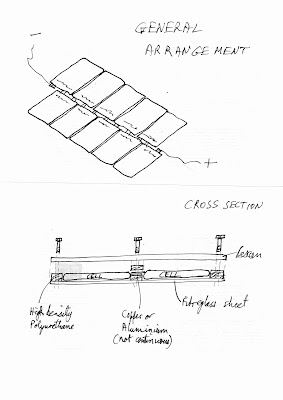
We've been talking about a flat pack for a few weeks to put under a Smart Car build or to test an A123 pack under a Speedster. This concept does well enough.
I suppose we jumped the gun describing the book, but I wanted a little context for the conversation, like who he was and where he was from. The book came up. The problem is it isn't precisely released yet, so you can't have one. But it should be on Amazon soon.
The other aspect we went on with in this video at some length and probably at some tedium was the JLD404AH Intelligent AH Meter. We actually found this meter BY ACCIDENT in a box of stuff we had ordered a year ago. We more recently found this DC Voltmeter that allowed you to set relays based on voltage and we kind of designed a bottom balancing circuit out of this very simply by connecting that control relay to a contactor and a 0.1 ohm 250watt power resistor. This little "bleeder" would bleed a cell at about 30 amps until it gets down to 2.50 volts, or really whatever value you set, and then disconnect the load.
But while rooting through a box of similar meters, we found this Intelligent AH Meter version. We had never hooked it up. And it was no longer available, and worse the documentation was no longer available.
But it was a pretty similar meter and we gradually were able to piece together how to work it. incredibly, the relays could be activated by Voltage on those as well. In fact, you could tie the relays to voltage, current, ampere-hours, or time in a way that is so flexible, you really can't quite work it all out mentally. It actually lets you set TWO levels an activation threshold and a deactivation threshold kind of like a thermostat.
A thermostat? Well yee. THis is the easiest example, which is unfortunate because this device does NOT measure temperature. But let's say you wanted to turn on a heater to bring a pot of water to a certain temperate and hold it there. Wouldn't it be nice to have a relay that would run the heater. IF the water is below 100 degrees for example, it energizes, turning on the heater. When it reaches 140 degrees it reenergizes, allowing the temperature to fall. But at 100 degrees, it comes on again. In this way, it cycles but without hystereses. It has a band gap.
That's how these relays work. And you can set them on an ascending curve or descending curve. And they can work on voltage, current, amp hours, or time.
The flexibility of all this hurts the head, so I won't pursue it. But it makes it a very handy little device.
We went back to the guy we bought this from and had a couple of weeks of discussion to get him to reprise it. We ordered a dozen, and put it in the video which we released Sunday noonish.
We also put a description and a way to order on our web site online store. By Monday morning, we had sold twelve. Of course, I already had two of our dozen on the lab bench. So we're not only sold out, but scrambling to get enough to fill the current orders.
This basically illustrates the ongoing need for instrumentation. We recently reviewed Valery Mitzikhov's EMW Dashboard. It turns out this hardware isn't done by EMW at all, but rather by Dmitri Butvinik, an online impresario we've crossed swords with before. The hardware literally came apart in our hands. And now that we know where its from, the odds of fixing the 5% accuracy problem are essentially none. I played with some GOOD hall effect sensor s a year ago and found accuracy to be a devilish problem. I assumed Valery, with a Phd in Physics, had some magic sauce on this topic since they used a hall effect sensor. As it turns out, no. He has simply bitten on a Dmitri device assuming it would report accurate current. It doesn't. And it can't. In fact it's a very cheap hall effect sensor to begin with. Dmitri and his followers are big fans of cheap.
In any event, we're going to piece together this AH meter, a 12v DC-DC converter to power it with full isolation from your pack voltage, a shunt that COULD be mounted with a bit of additional work, and a Operations Manual that yours truly has cobbled together to serve as some DOCUMENTATION for this device.
The device uses a shunt. We get rather inexpensive shunts from China that are 75 mv. Let's talk a little about current measurement. Everyone KNOWS all this, and in most cases know at least part of it wrong.
Basically to measure current, the most accurate and temperature stable way to do this is with a known small value of resistance. According to George Ohm, the amount of current through a given resistance is a function of the voltage you apply. Conversely, if you measure the voltage across a known resistance, you can calculate the current flow.
To measure high current levels, you want a very LOW resistance value so you dissipate a minimum of current as heat. The power dissipated will be a function of current level, times resistance, squared. So if you have a high level of current, you must have a very low value of resistance.
In the U.S., most shunts are machined to have a resistance where the full current level will cause a voltage drop of 50mv. For example, you might have a shunt that is rated at 100Amps/50mv. That means that if you run 100 amps through it, you would read 0.050 volts or 50 millivolts across the terminals as the voltage drop across that resistance. If we take that voltage and divide it by the current 0.050/500 we get the resistance of the shunt resistor - in this case 0.0001 ohms or 0.1 milliohms. Indeed a very small value. But if accurate enough, very useful.
Chinese meters almost always specify 75mv shunts. And so we are coupling this meter with a 1000A/75mv shunt. In the meter, there is a APuH value where you enter the full scale value of current - 1000 amps. And of course it has a fixed 75 mv input.
Because of this full scale variable, we can actually use ANY shunt with this menu. What you are setting is the number of amperes to display and to count in the AH calculation when the meter measures 75 millivolts. If we had a 500A/50mv shunt for example, it would never exhibit a voltage drop of 75mv until it carried 750 Amperes. No problem. Hook it up to the meter and enter 750 as the full scale current value.
Similarly, if you had a 100A/100mv shunt you wanted to use. How many amperes should you enter for 75 mv? Well, how about 75 amperes?
There are a couple of things to keep in mind here. First, it is just a fixed value of resistance. The maximum current that can be measured is a function of the METER primarily. In other words, we don't know what this meter does with inputs above 75 mv. So you want more or less to size your shunt so you never exceed the 75 mv.
The other criteria is that the power dissipated DOES heat the shunt slightly. If you run 1000 amps through a 100 A shunt, not good. It will heat it and that will affect accuracy and too much heating and the accuracy goes off permanently. But it is NOT precisely a problem to run 2000 amps through a 1000 amp shunt, or 1000 amps through a 500 amp shunt briefly. We just don't' know exactly what the meter is going to do with the information.

The other proviso is that the LOWER you go the more accurate you become. There is no point using a 1000 amp shunt in a buggy that will never do more than 200 amps. The scale is 75 mv to 1000 amps and so 1 mov of change in voltage represents 13.33 amperes. At a 300 amp shunt, each millivolt represents 4 amperes so you have a much more accurate scale, and you're not going over 300 amperes anyway.
Similarly, the 75 mv shunts are more accurate, all other things being equal, than the 50 mv shunts. You are simply using a wider voltage drop to represent the same change in current.
The EV community has faced a real challenge in finding current measurement and particularly kWh or AH accumulator/counters sized for our use. The only other market for such devices, aside from nuclear power plants, are solar power systems. ANd they tend to be 50 amp and 48v scale items. Similarly, some attention is paid by large boat and recreational vehicle owners. BUt again, 48v and 50amp or 100amp is pretty much the game there.
And so if you want to accurately measure 500 or 1000 amps and you have a pack voltage of 150 or 250 volts, there is really not much out there to find in the way of generic measurement devices.
The ability to measure 50 mv or 75 mv is actually chip based. There are some phenomenal operational amplifier chips out there to do this and have been for many years. The problem is that they are now ENTIRELY surface mount devices. I cannot find one that will measure both directions and provide a useful output in a larger chip format. And I cannot SEE much less solder SMT devices.

Hall effect devices CAN output higher values such as 0-5v or 4-20ma or even 0-10v that can be read with standard A/D circuits in multicrontroller devices such as Arduinos. But they become quite nonlinear outside of their defined range, and it is quite hard to find the zero point, even with temperature compensation. And so at these scales where we are charging at 25 amps and driving at 1300 amps and need to be able to measure both accurately, that can be difficult to do with hall effect devices. And not possible at all with undersized inexpensive ones.
We have used the Xantrex device for several years. It is kind of pricey at $250-$275. I cannot SEE the display in any lighting conditions. And the little terminal board in the back is very difficult to poke a wire into and get it to stay put. But we've lived with it. THe JLD404AH is the first meter I've found that does what I want, allows control based on AH, and that I can read.
But given the immediate dozen sales, I'm guessing we need to keep looking. Apparently, we are NOT the only people looking for instrumentation.
We'll try to expedite all current orders and get new stock in soonest.
Jack Rickard
He suggested a flat pack design and while a little rough and perhaps a little obvious, we pretty much liked the idea.

We've been talking about a flat pack for a few weeks to put under a Smart Car build or to test an A123 pack under a Speedster. This concept does well enough.
I suppose we jumped the gun describing the book, but I wanted a little context for the conversation, like who he was and where he was from. The book came up. The problem is it isn't precisely released yet, so you can't have one. But it should be on Amazon soon.
The other aspect we went on with in this video at some length and probably at some tedium was the JLD404AH Intelligent AH Meter. We actually found this meter BY ACCIDENT in a box of stuff we had ordered a year ago. We more recently found this DC Voltmeter that allowed you to set relays based on voltage and we kind of designed a bottom balancing circuit out of this very simply by connecting that control relay to a contactor and a 0.1 ohm 250watt power resistor. This little "bleeder" would bleed a cell at about 30 amps until it gets down to 2.50 volts, or really whatever value you set, and then disconnect the load.
But while rooting through a box of similar meters, we found this Intelligent AH Meter version. We had never hooked it up. And it was no longer available, and worse the documentation was no longer available.
But it was a pretty similar meter and we gradually were able to piece together how to work it. incredibly, the relays could be activated by Voltage on those as well. In fact, you could tie the relays to voltage, current, ampere-hours, or time in a way that is so flexible, you really can't quite work it all out mentally. It actually lets you set TWO levels an activation threshold and a deactivation threshold kind of like a thermostat.
A thermostat? Well yee. THis is the easiest example, which is unfortunate because this device does NOT measure temperature. But let's say you wanted to turn on a heater to bring a pot of water to a certain temperate and hold it there. Wouldn't it be nice to have a relay that would run the heater. IF the water is below 100 degrees for example, it energizes, turning on the heater. When it reaches 140 degrees it reenergizes, allowing the temperature to fall. But at 100 degrees, it comes on again. In this way, it cycles but without hystereses. It has a band gap.
That's how these relays work. And you can set them on an ascending curve or descending curve. And they can work on voltage, current, amp hours, or time.
The flexibility of all this hurts the head, so I won't pursue it. But it makes it a very handy little device.
We went back to the guy we bought this from and had a couple of weeks of discussion to get him to reprise it. We ordered a dozen, and put it in the video which we released Sunday noonish.
We also put a description and a way to order on our web site online store. By Monday morning, we had sold twelve. Of course, I already had two of our dozen on the lab bench. So we're not only sold out, but scrambling to get enough to fill the current orders.
This basically illustrates the ongoing need for instrumentation. We recently reviewed Valery Mitzikhov's EMW Dashboard. It turns out this hardware isn't done by EMW at all, but rather by Dmitri Butvinik, an online impresario we've crossed swords with before. The hardware literally came apart in our hands. And now that we know where its from, the odds of fixing the 5% accuracy problem are essentially none. I played with some GOOD hall effect sensor s a year ago and found accuracy to be a devilish problem. I assumed Valery, with a Phd in Physics, had some magic sauce on this topic since they used a hall effect sensor. As it turns out, no. He has simply bitten on a Dmitri device assuming it would report accurate current. It doesn't. And it can't. In fact it's a very cheap hall effect sensor to begin with. Dmitri and his followers are big fans of cheap.
In any event, we're going to piece together this AH meter, a 12v DC-DC converter to power it with full isolation from your pack voltage, a shunt that COULD be mounted with a bit of additional work, and a Operations Manual that yours truly has cobbled together to serve as some DOCUMENTATION for this device.
The device uses a shunt. We get rather inexpensive shunts from China that are 75 mv. Let's talk a little about current measurement. Everyone KNOWS all this, and in most cases know at least part of it wrong.
Basically to measure current, the most accurate and temperature stable way to do this is with a known small value of resistance. According to George Ohm, the amount of current through a given resistance is a function of the voltage you apply. Conversely, if you measure the voltage across a known resistance, you can calculate the current flow.
To measure high current levels, you want a very LOW resistance value so you dissipate a minimum of current as heat. The power dissipated will be a function of current level, times resistance, squared. So if you have a high level of current, you must have a very low value of resistance.
In the U.S., most shunts are machined to have a resistance where the full current level will cause a voltage drop of 50mv. For example, you might have a shunt that is rated at 100Amps/50mv. That means that if you run 100 amps through it, you would read 0.050 volts or 50 millivolts across the terminals as the voltage drop across that resistance. If we take that voltage and divide it by the current 0.050/500 we get the resistance of the shunt resistor - in this case 0.0001 ohms or 0.1 milliohms. Indeed a very small value. But if accurate enough, very useful.
Chinese meters almost always specify 75mv shunts. And so we are coupling this meter with a 1000A/75mv shunt. In the meter, there is a APuH value where you enter the full scale value of current - 1000 amps. And of course it has a fixed 75 mv input.
Because of this full scale variable, we can actually use ANY shunt with this menu. What you are setting is the number of amperes to display and to count in the AH calculation when the meter measures 75 millivolts. If we had a 500A/50mv shunt for example, it would never exhibit a voltage drop of 75mv until it carried 750 Amperes. No problem. Hook it up to the meter and enter 750 as the full scale current value.
Similarly, if you had a 100A/100mv shunt you wanted to use. How many amperes should you enter for 75 mv? Well, how about 75 amperes?
There are a couple of things to keep in mind here. First, it is just a fixed value of resistance. The maximum current that can be measured is a function of the METER primarily. In other words, we don't know what this meter does with inputs above 75 mv. So you want more or less to size your shunt so you never exceed the 75 mv.
The other criteria is that the power dissipated DOES heat the shunt slightly. If you run 1000 amps through a 100 A shunt, not good. It will heat it and that will affect accuracy and too much heating and the accuracy goes off permanently. But it is NOT precisely a problem to run 2000 amps through a 1000 amp shunt, or 1000 amps through a 500 amp shunt briefly. We just don't' know exactly what the meter is going to do with the information.

The other proviso is that the LOWER you go the more accurate you become. There is no point using a 1000 amp shunt in a buggy that will never do more than 200 amps. The scale is 75 mv to 1000 amps and so 1 mov of change in voltage represents 13.33 amperes. At a 300 amp shunt, each millivolt represents 4 amperes so you have a much more accurate scale, and you're not going over 300 amperes anyway.
Similarly, the 75 mv shunts are more accurate, all other things being equal, than the 50 mv shunts. You are simply using a wider voltage drop to represent the same change in current.
The EV community has faced a real challenge in finding current measurement and particularly kWh or AH accumulator/counters sized for our use. The only other market for such devices, aside from nuclear power plants, are solar power systems. ANd they tend to be 50 amp and 48v scale items. Similarly, some attention is paid by large boat and recreational vehicle owners. BUt again, 48v and 50amp or 100amp is pretty much the game there.
And so if you want to accurately measure 500 or 1000 amps and you have a pack voltage of 150 or 250 volts, there is really not much out there to find in the way of generic measurement devices.
The ability to measure 50 mv or 75 mv is actually chip based. There are some phenomenal operational amplifier chips out there to do this and have been for many years. The problem is that they are now ENTIRELY surface mount devices. I cannot find one that will measure both directions and provide a useful output in a larger chip format. And I cannot SEE much less solder SMT devices.
Hall effect devices CAN output higher values such as 0-5v or 4-20ma or even 0-10v that can be read with standard A/D circuits in multicrontroller devices such as Arduinos. But they become quite nonlinear outside of their defined range, and it is quite hard to find the zero point, even with temperature compensation. And so at these scales where we are charging at 25 amps and driving at 1300 amps and need to be able to measure both accurately, that can be difficult to do with hall effect devices. And not possible at all with undersized inexpensive ones.
We have used the Xantrex device for several years. It is kind of pricey at $250-$275. I cannot SEE the display in any lighting conditions. And the little terminal board in the back is very difficult to poke a wire into and get it to stay put. But we've lived with it. THe JLD404AH is the first meter I've found that does what I want, allows control based on AH, and that I can read.
But given the immediate dozen sales, I'm guessing we need to keep looking. Apparently, we are NOT the only people looking for instrumentation.
We'll try to expedite all current orders and get new stock in soonest.
Jack Rickard
Wednesday, February 22, 2012
The Cape Girardeau ENDURO.
Of batteries and range and endurance and costs and complexities and batteries....
This week we continue A123 module obsession AND we do some minor work on the Cadillac Elescalade.
Apparently the A123 cell thing is of intense interest to at least some segment of our viewership. If developed, it would appear to offer some alternative cell strategies. However, these are not entirely without difficulties.
A couple of items. We continue to have lab anomalies I'm hesitant to report in detail. The reason I can't share these with you guys is you guys. You shred me every time I do with a laundry list of how I SHOULD have done the test.
We are accustomed to testing large format cells - 160 Ah and 180 Ah units with the odd 400 Ah cell thrown in. It's true I've done quite a bit of work in the last year in pairing two 90Ah cells for 180 Ah.
Suddenly dealing with 20Ah cells is just a different world. 1/2Ah or even 1 Ah isn't anything on a 180Ah cell. It's not really much of anything on a 100 Ah cell. It's a LOT on a 20 Ah cell. And so our procedures and test equipment, which I am ALSO always testing, gets a little bollixed up on what I'm doing at any given moment.
IS the decrease in capacity from 19Ah to 17.8 Ah due to test equipment or have I damaged the cell? Or not fully charged it in the first place?
As everyone who has gone into real cell testing has discovered, defining fully discharged OR defining fully charged is actually a little squishy. You can fully charge the cell using anything you want. Let it rest a couple of hours, and it will take more using the same metric. Similarly on discharge. A "bit more" starts to get hard to define at 20 Ah.
But we have had some mysteries. Like bottom balancing four cells to exactly 2.50 volts and then charging the pack. When we discharge it, they are all out of b a lance again. So we repeat the process and they are BACK in balance again?
How about draining a cell to 2.50v and then leaving it overnight with NOTHING connected to it. To find the next day it is ruined at 0.85v. Wait a minute. Recharged it works fine again????
We do not see these sorts of things with the larger prismatic cells. I would characterize these A123 cells as about as stable as a burlap sack full of cats. But I don't know if that's a good thing or a bad thing.
More reality. Yes, I know you all are all packaging engineering experts and I was made to WATCH the other kids during art class in the second grade. But whatever I do adds 1/3 to the weight and volume of A123 cells. You can pretty much figure that if it takes 10 cells and they weigh .496grams each that will be 4.96 kg. My package will be 4.96 x 1.33 or 6.6kg. So any increase in energy density you "imagine" from these cells is not only not possible, but if I'm doing the packaging there is a penalty here. A half sized pack doesn't get you half the range. It probably gets you 1/3 the range. So your 100 mile car with a pack that costs slightly MORE than half a pack probably actually delivers 1/3 the range or 35 miles or so.
Similarly the costs. Yes, it's $100 for resin. Let's try polycarbonate at $150. Or straw, at $90. Whatever I do, at least in prototype, dramatically increases the cost of these cells which STARTED OUT very pricey themselves. As their price has fallen, the percentage devoted to connectors and resin and molds and so forth has risen as a percentage.
So despite my obsession with these cells and posing them as a low cost alternative because of their high power output, reality keeps intervening to make it clear to me that this will NEVER be my choice for cells in a car. The large format leggo block 180Ah CALB is the battery of choice for me in designing a car at the moment. And I would list A123's as "problematical".
But that's not to say some effort making them LESS problematical isn't in order.
On the good side, despite my totally ruined mold, the 13.2v 120 Ah battery is testing well at about 113 Ah without any real overcharging or over discharging. I have mentioned some oddities but the cells seem to still be ticking along. But from what I am seeing I can see new insight into why some are so focused on top balancing BMS systems. They are a brute force way of making these cells do your bidding or appear to. I suspect there is another better way, but I'm still looking for it.
And the 13.3v package is looking pretty good to me in camp green and black. It is a little heavy at 36 lbs was it? But obviously durable. All cells are available at the top, perhaps too much so. A dropped wrench on this one would be fireworks. I might put some effort into a soft rubber "cap" made out of the silicon rubber mold material. Pour it on, let it cure, and pull it off. Then you make your connections and mash it back on to secure the terminals. Kind of a soft rubber hoodie for a battery.
All this is kind of stalling out our larger projects. But I confess I am having some fun. ANd it feels like we are just doing some things very differently from the OEM's and the very elegant high tech style so in vogue. But I kind of think "car stuff" out to be a little more rough and tumble along the lines of the SLI battery, which has evolved over 100 years - in fact we missed the anniversary of Kettering's electric start automobile 100th anniversary this week.
The 1912 Cadillac Touring Edition was first to eliminate the hand crank and opened up driving to everyone. Cadillac founder Henry M. Leland, who had already pioneered electric lights and electric ignition on his cars, worked closely with Charles F. Kettering, the inventor of the electric starter, to incorporate the device into his cars. The electric starter also was GM’s first electric motor – a core business today anticipating the growth in the electrification of the automobile.

Point is, that battery has been "evolving" for a century now. It looks the way it does for a reason, or a million reasons. It arrived in Darwinian fashion to be exactly what it is. And so using that as a starting point is not a bad, if slightly blind, strategy.
But new ideas are good too. And so we are casting about. We have used several. We used the alternating cells on the nylon threaded rod. I liked that, but it buried our terminals. We kind of stress tested it, which on reflection may not have been good medicine. But it got us to a pretty gruesome failure quickly which prevents spending more time on such a thing and then having it blow later.
We then mimicked the individual cell thing we already get from China. A word about that. I've heard a lot about just using similar boxes and similar terminals from China. Well, I've looked for them on Alibaba and I can't find them. If you can find who makes those, yes, I wold prefer to just buy the existing hardware and plastic extruded boxes, even if I had to cut them down a bit. Haven't found a source.
And this to the concept of ideas. An idea is not a general piece of shit on a napkin. They work better with measurements, specific product recommendations, and sources. "Expanding foam" is fine. But there are a brazillian. Similarly urethane resins, polycarbonate, silicon rubber, etc. ALl have different cure times, shore hardness, tensile strength, exothermic reaction, temperature tolerance, etc etc. ad nauseum.g
This is why I can be a little short with some of the arm chair theorists. If you've really thought this through by looking up at the ceiling, you're not in the same category as someone like Nabil or Peter who have hooked some of this up and then had an idea they don't have the resource to implement. And then if you're a Damien Maguire or Paul Holmes are someone in that category, just send me a list of parts you need and a delivery address and we'll wait for YOUR video.
I did include a segment of Damien Maguire's in this episode. If you were looking for someone to liven up the pace of conversation, Damien is more in my camp than out of it. But he does some interesting and of course tedious work on bottom balancing and shows you the ugly end of it on his BMW and so I included the entire video he uploaded to YouTube. I think he will find bottom balancing surprisingly effective in a lot of ways, and no easier than he thought.
I was reminded by the head of REAP systems, a leading BMS developer at the EVCCON that while bottom balancing might be more effective than top balancing, at least arguably, it was not very convenient. My response to him, and to Damien, is that in all the battery testing we've done, across several years and now locations, I've never once had a SINGLE LiFePo4 cell express ANY interest at all in my convenience. They are just curiously agnostic and apparently have no feelings for MY feelings whatsoever. But on the other hand, if I ask one to do the dive for the cause at my behest, they will head toward zero volts so fast you think they actually LIKE to give their lives in order to save mine. Valient. Just valiant. Splendid behavior.
This week I'm working on a new supur sekert module project. We are code naming this one the FLATENUM SERIES. It will be a flat pack designed to slide under Speedster Duh and ultimately get hooked up to it to provide 120v of juice at 60Ah. I have kind of a theory that this small Ah pack will act as a pack stiffener - holding the voltage up on acceleration. After acceleration, it would be restored by the larger prismatic pack to an identical state. This appears obvious. But it either may or may not be TRUE. We haven't really done such a thing. I would THINK it will work and instead of plunging to 106v on a hard acceleration we should maintain up at about 114 or even 116volts. This means more power through the controller to the wheels.
it should add about 200 lbs to the car, but in theory another 25 miles as well.
To make all things fair, i'll just quietly mention in passing that we are considering an addition to the Drag Race and Autocross at EVCCON this year. It will be a two hour race we will call the EVTV ELECTRIC ENDURO. It will run through a very SCENIC fall drive from Cape Girardeau up the hilly twisty U.S. 61 to Perrryville Missouri, thence across highway 51 to Illinois, where it will pick up Illinois highway 3 down the banks of the Mississippie before recrossing at the Cape Girardeau Bill Emerson Bridge back into town. And it looks like 127 miles on the map.
I think Speedster Redux can make it now and Speedster Duh likely will make it after the A123 addition if it works. But if you're working on an extender pack, battery trailer, etc there may well be a showcase for it in the EVTV Enduro. Probably a timed race rather than a true road race. Time and the ability to complete being the issue.
View Larger Map
I may try to arrange some charging in Perryville for those who want to try half of it, and still get back to the festivities without a flatbed. Yes, the entire concept is for this very beautiful scenic country drive to be just beyond your reach. An electric road race no one can finish. That's just the way my mind works. I would have been different had I been born a TALL instead of a ROUND. But I'm still around.
One other element that will apply to drag race, autocross, and endure - anti homolugation. If you have produced over 100 of these vehicles, you cannot compete other than exhibition only. It must be a custom conversion or VERY small run OEM with less than a hundred instances on the road. We remain TEsla Fanboyz too, but that's not really what EVCCON is about.
Jack Rickard
This week we continue A123 module obsession AND we do some minor work on the Cadillac Elescalade.
Apparently the A123 cell thing is of intense interest to at least some segment of our viewership. If developed, it would appear to offer some alternative cell strategies. However, these are not entirely without difficulties.
A couple of items. We continue to have lab anomalies I'm hesitant to report in detail. The reason I can't share these with you guys is you guys. You shred me every time I do with a laundry list of how I SHOULD have done the test.
We are accustomed to testing large format cells - 160 Ah and 180 Ah units with the odd 400 Ah cell thrown in. It's true I've done quite a bit of work in the last year in pairing two 90Ah cells for 180 Ah.
Suddenly dealing with 20Ah cells is just a different world. 1/2Ah or even 1 Ah isn't anything on a 180Ah cell. It's not really much of anything on a 100 Ah cell. It's a LOT on a 20 Ah cell. And so our procedures and test equipment, which I am ALSO always testing, gets a little bollixed up on what I'm doing at any given moment.
IS the decrease in capacity from 19Ah to 17.8 Ah due to test equipment or have I damaged the cell? Or not fully charged it in the first place?
As everyone who has gone into real cell testing has discovered, defining fully discharged OR defining fully charged is actually a little squishy. You can fully charge the cell using anything you want. Let it rest a couple of hours, and it will take more using the same metric. Similarly on discharge. A "bit more" starts to get hard to define at 20 Ah.
But we have had some mysteries. Like bottom balancing four cells to exactly 2.50 volts and then charging the pack. When we discharge it, they are all out of b a lance again. So we repeat the process and they are BACK in balance again?
How about draining a cell to 2.50v and then leaving it overnight with NOTHING connected to it. To find the next day it is ruined at 0.85v. Wait a minute. Recharged it works fine again????
We do not see these sorts of things with the larger prismatic cells. I would characterize these A123 cells as about as stable as a burlap sack full of cats. But I don't know if that's a good thing or a bad thing.
More reality. Yes, I know you all are all packaging engineering experts and I was made to WATCH the other kids during art class in the second grade. But whatever I do adds 1/3 to the weight and volume of A123 cells. You can pretty much figure that if it takes 10 cells and they weigh .496grams each that will be 4.96 kg. My package will be 4.96 x 1.33 or 6.6kg. So any increase in energy density you "imagine" from these cells is not only not possible, but if I'm doing the packaging there is a penalty here. A half sized pack doesn't get you half the range. It probably gets you 1/3 the range. So your 100 mile car with a pack that costs slightly MORE than half a pack probably actually delivers 1/3 the range or 35 miles or so.
Similarly the costs. Yes, it's $100 for resin. Let's try polycarbonate at $150. Or straw, at $90. Whatever I do, at least in prototype, dramatically increases the cost of these cells which STARTED OUT very pricey themselves. As their price has fallen, the percentage devoted to connectors and resin and molds and so forth has risen as a percentage.
So despite my obsession with these cells and posing them as a low cost alternative because of their high power output, reality keeps intervening to make it clear to me that this will NEVER be my choice for cells in a car. The large format leggo block 180Ah CALB is the battery of choice for me in designing a car at the moment. And I would list A123's as "problematical".
But that's not to say some effort making them LESS problematical isn't in order.
On the good side, despite my totally ruined mold, the 13.2v 120 Ah battery is testing well at about 113 Ah without any real overcharging or over discharging. I have mentioned some oddities but the cells seem to still be ticking along. But from what I am seeing I can see new insight into why some are so focused on top balancing BMS systems. They are a brute force way of making these cells do your bidding or appear to. I suspect there is another better way, but I'm still looking for it.
And the 13.3v package is looking pretty good to me in camp green and black. It is a little heavy at 36 lbs was it? But obviously durable. All cells are available at the top, perhaps too much so. A dropped wrench on this one would be fireworks. I might put some effort into a soft rubber "cap" made out of the silicon rubber mold material. Pour it on, let it cure, and pull it off. Then you make your connections and mash it back on to secure the terminals. Kind of a soft rubber hoodie for a battery.
All this is kind of stalling out our larger projects. But I confess I am having some fun. ANd it feels like we are just doing some things very differently from the OEM's and the very elegant high tech style so in vogue. But I kind of think "car stuff" out to be a little more rough and tumble along the lines of the SLI battery, which has evolved over 100 years - in fact we missed the anniversary of Kettering's electric start automobile 100th anniversary this week.
The 1912 Cadillac Touring Edition was first to eliminate the hand crank and opened up driving to everyone. Cadillac founder Henry M. Leland, who had already pioneered electric lights and electric ignition on his cars, worked closely with Charles F. Kettering, the inventor of the electric starter, to incorporate the device into his cars. The electric starter also was GM’s first electric motor – a core business today anticipating the growth in the electrification of the automobile.

Point is, that battery has been "evolving" for a century now. It looks the way it does for a reason, or a million reasons. It arrived in Darwinian fashion to be exactly what it is. And so using that as a starting point is not a bad, if slightly blind, strategy.
But new ideas are good too. And so we are casting about. We have used several. We used the alternating cells on the nylon threaded rod. I liked that, but it buried our terminals. We kind of stress tested it, which on reflection may not have been good medicine. But it got us to a pretty gruesome failure quickly which prevents spending more time on such a thing and then having it blow later.
We then mimicked the individual cell thing we already get from China. A word about that. I've heard a lot about just using similar boxes and similar terminals from China. Well, I've looked for them on Alibaba and I can't find them. If you can find who makes those, yes, I wold prefer to just buy the existing hardware and plastic extruded boxes, even if I had to cut them down a bit. Haven't found a source.
And this to the concept of ideas. An idea is not a general piece of shit on a napkin. They work better with measurements, specific product recommendations, and sources. "Expanding foam" is fine. But there are a brazillian. Similarly urethane resins, polycarbonate, silicon rubber, etc. ALl have different cure times, shore hardness, tensile strength, exothermic reaction, temperature tolerance, etc etc. ad nauseum.g
This is why I can be a little short with some of the arm chair theorists. If you've really thought this through by looking up at the ceiling, you're not in the same category as someone like Nabil or Peter who have hooked some of this up and then had an idea they don't have the resource to implement. And then if you're a Damien Maguire or Paul Holmes are someone in that category, just send me a list of parts you need and a delivery address and we'll wait for YOUR video.
I did include a segment of Damien Maguire's in this episode. If you were looking for someone to liven up the pace of conversation, Damien is more in my camp than out of it. But he does some interesting and of course tedious work on bottom balancing and shows you the ugly end of it on his BMW and so I included the entire video he uploaded to YouTube. I think he will find bottom balancing surprisingly effective in a lot of ways, and no easier than he thought.
I was reminded by the head of REAP systems, a leading BMS developer at the EVCCON that while bottom balancing might be more effective than top balancing, at least arguably, it was not very convenient. My response to him, and to Damien, is that in all the battery testing we've done, across several years and now locations, I've never once had a SINGLE LiFePo4 cell express ANY interest at all in my convenience. They are just curiously agnostic and apparently have no feelings for MY feelings whatsoever. But on the other hand, if I ask one to do the dive for the cause at my behest, they will head toward zero volts so fast you think they actually LIKE to give their lives in order to save mine. Valient. Just valiant. Splendid behavior.
This week I'm working on a new supur sekert module project. We are code naming this one the FLATENUM SERIES. It will be a flat pack designed to slide under Speedster Duh and ultimately get hooked up to it to provide 120v of juice at 60Ah. I have kind of a theory that this small Ah pack will act as a pack stiffener - holding the voltage up on acceleration. After acceleration, it would be restored by the larger prismatic pack to an identical state. This appears obvious. But it either may or may not be TRUE. We haven't really done such a thing. I would THINK it will work and instead of plunging to 106v on a hard acceleration we should maintain up at about 114 or even 116volts. This means more power through the controller to the wheels.
it should add about 200 lbs to the car, but in theory another 25 miles as well.
To make all things fair, i'll just quietly mention in passing that we are considering an addition to the Drag Race and Autocross at EVCCON this year. It will be a two hour race we will call the EVTV ELECTRIC ENDURO. It will run through a very SCENIC fall drive from Cape Girardeau up the hilly twisty U.S. 61 to Perrryville Missouri, thence across highway 51 to Illinois, where it will pick up Illinois highway 3 down the banks of the Mississippie before recrossing at the Cape Girardeau Bill Emerson Bridge back into town. And it looks like 127 miles on the map.
I think Speedster Redux can make it now and Speedster Duh likely will make it after the A123 addition if it works. But if you're working on an extender pack, battery trailer, etc there may well be a showcase for it in the EVTV Enduro. Probably a timed race rather than a true road race. Time and the ability to complete being the issue.
View Larger Map
I may try to arrange some charging in Perryville for those who want to try half of it, and still get back to the festivities without a flatbed. Yes, the entire concept is for this very beautiful scenic country drive to be just beyond your reach. An electric road race no one can finish. That's just the way my mind works. I would have been different had I been born a TALL instead of a ROUND. But I'm still around.
One other element that will apply to drag race, autocross, and endure - anti homolugation. If you have produced over 100 of these vehicles, you cannot compete other than exhibition only. It must be a custom conversion or VERY small run OEM with less than a hundred instances on the road. We remain TEsla Fanboyz too, but that's not really what EVCCON is about.
Jack Rickard
Subscribe to:
Posts (Atom)
